

CapitalPath Daily
नजदीकी फायदा देखने से पहले, दूर का नुकसान सोचना चाहिए
A pension contract with a premium provider, or an ETF savings plan you run yourself? A Daily built on a line from the Hindi film Sarkar (2005), with a worked example on tax when you switch funds.
Nilesh Kulkarni · CapitalPath
Updated

Nazdeeki faayda dekhne se pehle, door ka nuksaan sochna chahiye.
Translation (ours): “Before you look at the gain close at hand, think about the loss further down the road.”
The idea
The line above belongs to Subhash Nagre, known as “Sarkar” and played by Amitabh Bachchan, in Ram Gopal Varma’s 2005 Hindi film Sarkar, and it is one of the film’s most widely quoted dialogues. The film is a political crime drama set in Mumbai, about power, family and loyalty, and the scene has nothing to do with money.
Even so, it fits a choice many people face when they start saving for the long haul: a pension contract with a premium private pension provider, or doing it yourself with an ETF savings plan in your own depot. The near gain sits with the depot. It is cheaper in the early years, with no set-up costs and usually lower running costs. With a premium provider you pay more at the start, and in return you get more security through fixed rules for the build-up phase, usually the option of an income for life, and a tax advantage that only shows after many years.
The distant loss in the depot is tax. If you rebalance or switch funds a few times over 30 years, you sell units and realise gains, and each time Germany’s flat-rate tax on investment income plus the solidarity surcharge falls due. Whatever goes to the tax office stops growing with the rest. Inside a unit-linked pension policy, fund switches during the build-up trigger no tax at all. Tax is charged when the money is paid out, and if you take a lump sum after your 62nd birthday and at least twelve years in the contract, usually only half of the gain is taxed at your personal rate.
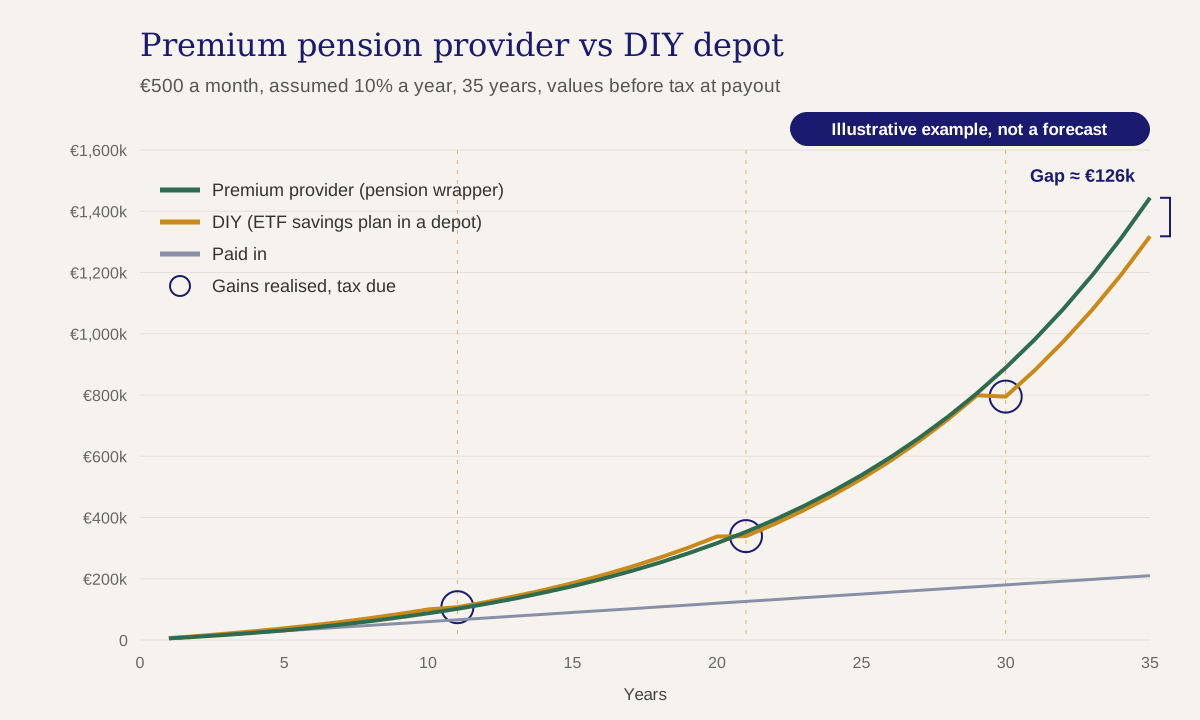
The chart below works this through for €500 a month over 35 years. The depot stays ahead until around year 20, because the contract costs more. After the second switch the contract pulls ahead, and after 35 years it stands at about €1.44m against about €1.32m, before tax at payout. Once that tax is roughly allowed for, the gap comes down to around €32,000, and with different costs, returns or tax rates it could be smaller or go the other way. It also only works if the contract runs its full course. According to the Verbraucherzentrale, Germany’s consumer advice service, cancelling early gets you just the surrender value, from which acquisition and sales costs and a cancellation charge can be deducted. That is why the CapitalPath approach starts with understanding. How long-term provision can be put together is covered on the private retirement page.
A fictional story
The people and the events are invented.
Daniel is 32 and works as an electrical engineer in Kassel. Since his pay rise in the spring he has wanted to put €500 a month aside for later, and he has two options on his desk: a quote from a premium private pension provider, and the ETF savings plan he could set up himself in ten minutes. His colleague Jonas spots the quote by the coffee machine and pulls a face. “Look at those set-up costs. Just do it yourself, it’s far cheaper.”
That evening Daniel runs the numbers, and for the first few years Jonas is right, because the depot is comfortably ahead. Then he remembers Jonas telling him, a couple of years back, how much tax he paid when he moved his funds around. Daniel wonders how often he would reshuffle things over 35 years, as his life changes or a fund stops suiting him, and three times seems on the low side. He works it through with three switches anyway, purely as an example, and the contract overtakes the depot a little after year twenty. He also notices that both routes get taxed in the end, which makes the gap smaller than he first thought.
He isn’t signing anything tonight. Instead he records a voice message for his sister Lena, who works for a tax adviser: “You know this stuff. If I stick with it for 35 years and switch a few times, what does the depot cost me in tax, and what happens with the contract when it pays out?” Her reply arrives two minutes later, a single line: “Bring both sets of papers on Sunday and we’ll go through it together.”
What this means
01
A premium private pension provider costs more at the start than an ETF savings plan in your own depot. Whether that pays off only becomes clear over decades, and it depends on the costs, on how long you keep going and on how often you would switch.
02
In a depot, every sale at a profit triggers the flat-rate tax, above the annual allowance and, for equity funds, after the partial exemption. Inside a unit-linked pension policy, fund switches during the build-up are tax-free, and tax is charged at payout.
03
Neither route is tax-free in the end. In the example the gap shrinks a lot once tax at payout is counted, so any fair comparison has to include it.
04
A long contract only pays off if it actually runs for a long time. According to the Verbraucherzentrale, cancelling early gets you just the surrender value, so before you sign it is worth asking whether you can keep up the payments for the whole term.
Explore this further
Sources & further reading
- Sarkar (2005 film) (opens in a new tab)
Wikipedia, credits for director, production and cast (Amitabh Bachchan as Subhash Nagre alias “Sarkar”) · accessed 11 October 2026
- Sarkar (2005) (opens in a new tab)
IMDb, film title page · accessed 11 October 2026
- Sarkar (2005), Cast and Crew (opens in a new tab)
Box Office Mojo (IMDb), cast entry “Amitabh Bachchan, Subhash Nagre ‘Sarkar’” · accessed 11 October 2026
- Filmy Dialogue in Hindi: सरकार फिल्म का डायलॉग (opens in a new tab)
Navbharat Times, collection of well-known film dialogues (lists the line as Amitabh Bachchan’s dialogue in Sarkar) · accessed 11 October 2026
- Lebensversicherung kündigen? Diese Alternativen sind oft besser! (opens in a new tab)
Federation of German Consumer Organisations (Verbraucherzentrale), verbraucherzentrale.de · accessed 11 October 2026
- § 20 Einkommensteuergesetz (EStG), Kapitalvermögen (opens in a new tab)
German Federal Ministry of Justice, gesetze-im-internet.de (para. 1 no. 6 on taxing insurance payouts, para. 9 on the annual allowance) · accessed 13 October 2026
- § 20 Investmentsteuergesetz (InvStG), Teilfreistellung (opens in a new tab)
German Federal Ministry of Justice, gesetze-im-internet.de (partial exemption for equity funds) · accessed 13 October 2026
Creation note
This content may be created using AI assistance.
A short note
This is general information and orientation, not individual advice.