

CapitalPath Daily
A little, every month
Why waiting for a lump sum often delays saving for years, and what a small regular amount can do instead. A Daily with a verified quote from Ovid.
Nilesh Kulkarni · CapitalPath
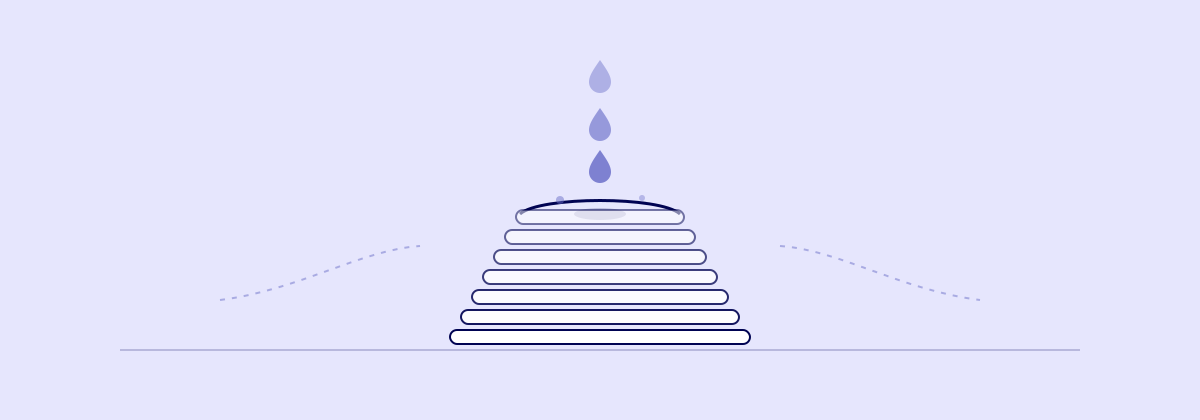
Gutta cavat lapidem, consumitur anulus usu.
The idea
Ovid spent the last years of his life in exile on the Black Sea coast, sending letters in verse back to Rome. One of them, addressed to his friend Albinovanus, contains the line “Gutta cavat lapidem, consumitur anulus usu”: dripping water wears a hollow in stone, and a ring grows thin with use. Ovid was listing everything that time grinds down and complaining that his own misery seemed to be the one thing it spared. The first half has long outlived the complaint and survives as a saying about patience and persistence.
When it comes to building savings, plenty of people wait for a lump sum: a tax refund, a bonus, the month when there is finally more left over. Germany’s consumer advice centres, the Verbraucherzentrale, point out that savings plans are usually available from as little as one euro a month, and that with an ETF savings plan you can change the amount, pause it and pick it up again whenever you like. They are also clear that regular plans tend to cost a little more overall than one large investment. In return you don’t have to arrange each new investment yourself, which is exactly where good intentions tend to stall.
In the CapitalPath approach, Build is the third step, after a cash buffer for everyday life and cover for what would be hard to replace. For investments whose value can go up and down, the Verbraucherzentrale talks about money you are very unlikely to need in the next five years. With those foundations in place, a modest amount that leaves your current account every month will often do more than a large sum that never quite arrives.
A fictional story
The people and the events are invented.
Malte is 36 and works as a master electrician for a small firm. For years he has meant to start saving properly as soon as he has a decent sum to put in. In spring it was going to be the tax refund, which went on new tyres. In autumn it was going to be the Christmas bonus, but after presents and a catch-up bill for the flat’s service charges there was so little left that he pushed the whole idea back another year.
In January he drives out to a site with his colleague Aylin. She mentions, almost in passing, that a small amount has gone into a savings plan every month since her apprenticeship and that she stopped noticing it years ago. That evening Malte goes through last year’s bank statements. Nearly every month there was something left at the end, and a few days later it had quietly disappeared into everyday spending. He had topped up his emergency savings over the summer and sorted out income protection the year before. The only thing really in the way was the waiting.
He settles on an amount he wouldn’t miss even in an expensive month, say 50 euros purely as an example, and texts his partner Jana: “From the first, a bit goes out every month. Not much, but every time. If money gets tight I’ll pause it. Will you sit down and look at it with me in the summer?” Jana sends back a thumbs-up and adds: “So no more waiting for Christmas, then.”
What this means
01
Waiting for one big sum often means never starting. A small amount that goes out regularly turns an intention into a habit.
02
According to the Verbraucherzentrale, savings plans usually start from one euro a month, and with an ETF savings plan the amount can be changed, paused and resumed at any time.
03
Regular plans tend to cost a little more overall than a single large investment. The trade-off is that you don’t have to decide afresh each time, which makes it easier to keep going.
04
Building comes after the buffer and the cover. The monthly amount should come from money you won’t need even in a bad month.
Explore this further
Sources & further reading
- Epistulae ex Ponto, book IV, letter 10 (to Albinovanus), line 5 (opens in a new tab)
Ovid (P. Ovidius Naso) — Latin text on The Latin Library · c. AD 14 (accessed 9 October 2026)
- Geldanlage und Altersvorsorge: So legen Sie Ihr Erspartes am besten an! (as of 21 January 2026) (opens in a new tab)
Verbraucherzentrale (German consumer advice centres) · accessed 9 October 2026
Creation note
This content may be created using AI assistance.
A short note
This is general information and orientation, not individual advice.